The other day I gave my criticism of a prepper's guide to "Survival Food for the Poor." As I mentioned in my critique the biggest problem with the suggestions given in the guide boiled down to lack of nutrient density and an over abundance of carbs.
Rather than leaving you with a mere criticism I promised that I would provide an alternative list of foods to stock up on while still retaining the budgetary spirit of the original list.
My suggestions follow:
1- Water: It truly cannot be overemphasized. Water is necessary for life, plain and simple. The minimum needed is about half of a gallon per person, per day. However, you truly cannot have too much water as, even if you have more than you can drink (unlikely) water can also be used to cook, clean, grow foods etc. I recommend storing at least 2 gallons of water, per person, per day for a minimum of 2 weeks. This sounds like a lot of water but water is very cheap. It is cheap to buy, even cheaper to bottle/can tap water. Don't forget to have an alternative water collection source beyond your stores be it access to a body of water coupled with water purification methods (tabs or filters) or even a rain barrel or two.
2- Brown Rice: This is one of the few carb rich foods you will see me recommend in this list but I do so never the less for a few reasons. First of all, rice coupled with beans will provide the range of amino acids. Not as good as meat, fish or fowl, but very good and additionally, very cheap. As I mentioned in my last post, don't let the reduced shelf life brown rice has compared to white rice trick you into opting for the latter as it literally pales in comparison. Furthermore, the shelf life of brown rice if properly stored is still about 2 years, which is more than enough. An added benefit to storing brown rice beyond the fact that it contains more nutrients than its white counterpart is the fact that you can actually plant it and expect something to grow later (given you live in a moist enough climate.) As it turns out, most places which you can buy both brown and white rice, they tend to be the same price. Well... kind of, they are the same price per pound, by per nutrient, brown rice is actually cheaper.
3- Dried Beans/Lentils: A necessary counterpart to brown rice. Together you will be getting a complex amino acid profile with a food that stores indefinitely and is tremendously inexpensive. I recommend a variety of dried beans and lentils as each provides a slightly different nutrient values, but more importantly you can enjoy a variety of flavors, textures and colors which will assist in keeping up morale. If you want to get the absolute most bang for your buck, check the nutrient labels and stick with the beans and lentils that afford the highest amount of protein and fat per unit. Typically this will be things like split peas and garbanzo beans.
4- Nut Butters: These will be a valuable source of both fats and proteins while giving a unique flavor addition to your stores. There are dried options of things like peanut butter which can store for many years, but if properly canned and stored, just the nut butters themselves can last upwards of 15 years too. My same reasoning as with brown rice (if you are still eating your stores out of necessity years from now, you need an additional food allocation plan in motion) applies with non-dehydrated nut butters. In addition, the dehydrated forms actually contain less fat and require water and preparation time and effort. When picking nut butters select options that contain as few additional ingredients as possible, particularly sugars. Instead, opt for "natural" versions which should contain nothing more than the nut in question, and salt. These will store longer, be more nutrient dense, and contain more nutrient value per dollar, even if they are slightly more expensive at face value.
5- Dehydrated Eggs: This may be slightly less palatable than the fresh versions, however they are pretty inexpensive and will provide you with the top tier protein available, even if you have to reconstitute them. Honestly, most people can't tell the difference as many of the eggs consumed in restaurants are reconstituted from dry.
6- Dehydrated and Canned Dairy Products: Most people are familiar with dehydrated milk, but you can also get dehydrated cheese, sour cream and even butter. Canned versions of each of these if you can fit it into your budget as they taste better and have more fat retained. This is where I would have ended my commentary on this category, but thanks to the wonderful world of other preppers on the internet I found viable ways to can milk, butter and cheese so perhaps you can get the best at an inexpensive price after all just for exchanging a little bit of labor.
7- Fish Canned in Oil: Canned fish in general will be the best, and likely cheapest, source of "meat" that you'll be able to find. There are certain options which are better than others (eg. whole albacore vs. chunk tuna) but this will boil down to price and preference. Even if you get the bottom of the line versions of canned fish, the nutrients will still be very high. Canned fish will also be a source of nutrients like iodine, which will likely be lacking from the rest of your food stores. I recommend choosing oil canned fish rather than water, simply because the price is typically the same, but you will be adding additional fat content. If possible and within reason of price, try to get olive oil rather than canola oil or soybean oil, but this is about emergency rations, not ideal diet, so the fat afforded by even substandard oils such as soybean oil is still a good idea to get for your stores.
8- Bone Broth: This is likely to be the most unique suggestion on this list simply because it really isn't something that you can go out and buy. Bone broth is a tremendously healthful food as it contains readily assimilated nutrients. While you can't go to the store and buy a pallet of bone broth, you can gradually accumulate it for your stores (a strategy you should employ to satisfy all of your food stores by the way). Each time you eat something with bones: chicken, ribs, thanksgiving turkey etc. throw the extra bones in a freezer bag, once it is full, boil the bones with enough water to submerge them and a tablespoon or two of vinegar for 2 or 3 days. This is most easily achieved by means of a crock pot as it will keep a low but constant heat with minimal power. After straining the bones and lil bits of leftover meat, cartilage and fat, can the remaining bone broth. Don't fret if the contents gel, that just means its good for you.
9- Dehydrated Dark Leafy Greens: This is pretty much the only "veggie" that you'll see on my list. Part of the reason for this is that the more nutrient dense dairy, egg, and fish you eat, the less necessary many vegetables actually are. Another reason is that most of the vegetables you consume should be sourced from your garden. However, for sake of variety and just to be certain about getting vitamins and minerals it is a good idea to include leafy greens, basically the most nutrient dense vegetable option. This is another suggestion that will require some work on your part however, but yet again, the work is minimal and affords huge pay off. You can buy greens and dehydrate them, but if you aren't yet gardening (shame on you) creating food stores may be a good excuse for you to start since leafy greens are pretty easy to grow and usually have a very high yield. I recommend in particular kale, chard and turnip greens. Each of these have an enormous amount of vitamins and minerals per unit, turnip greens in particular even offer a high calcium profile. To prepare these for storage either use a food dehydrator, or lay leaves out on a few baking sheets and leave in the oven at 200F until they are completely dry. They will be very dry and crumbly at this point, which is good because you can then crumble them into swing top jars and fill them quite densely. Try to limit the amount of stems put in as these contain less nutrients and are more bulky. To use these dried leafy greens you can just sprinkle them into soups etc. to increase the vitamin and mineral content of a meal.
10- Unrefined Sea Salt: "That sounds pretty fancy" you may be saying to yourself, and yes, compared to industrial refined iodized salt, it kind of is, if by fancy you mean "nutrient dense" that is. Unrefined sea salt contains trace minerals which will benefit you while still serving the versatile purposes of salt such as flavor modification, preservation, sanitation, and providing much needed sodium. Is unrefined sea salt more expensive than industrial refined iodized salt? Yes it is, but we're talking salt here so its still really cheap. This is a store that I really can't imagine you storing too much of either. 100 lbs of salt sounds like a lot, but remember that its cheap, versatile, and stores easily. The worse case scenario with storing "too much" salt, would be that you could use it as a much sought after trade commodity in a post-collapse scenario.
11- Honey: This could be classified as a "luxury" option. But honey is an important addition to any food store. For one its sweet, and thats actually a good thing, sometimes its good to have sweet things around to help keep up morale. However, honey is more than just empty sugar calories. It has a strong anti-microbial quality that will actually assist with immunity from disease. Additionally if you are consuming honey which was created locally, you will receive a reduction in allergy affliction.
12- Dried Spices/Teas: Again a "luxury" option at face value, but don't underestimate the importance of WANTING to eat the food that you've stored. I don't' care how much variety you've dried to build into your food stores, you will start to get a little tired of the daily fare. One way to fight against this malaise is to literally spice things up. More importantly, many spices contain additional benefits than simply flavor. Dried chile flakes and powder will provide capsaicin, a chemical which helps a variety of ailments for example. Teas are another good idea as they will give some flavor variety to your drinking options while providing additional benefits. I suggest in particular: chamomile, red raspberry leaf (particularly for women), ginger and peppermint. However, go check out your local tea selection, many of them list the ailments for which they will benefit the imbiber on the packaging.
13- Vinegar: If possible, get apple cider vinegar with a mother. I suggest this because it is contains more benefits which can be easily assimilated by the body than refined white vinegar affords. The reason I suggest that you get vinegar "with mother" is that if emergency situations are greatly prolonged, you can actually make more vinegar since you have the mother culture in the bottle too. Whatever kind of vinegar you end up getting, don't skimp on amounts. While the average person may not use a lot of vinegar day to day, you mustn't forget the nutritional benefits of adding vinegar to food and drink, nor the preservative and sanitation qualities vinegar possesses. Vinegar is yet another store that should be stored in large amounts due to its versatility, inexpensive nature, and potential future as a trade commodity.
14- Cheap Vodka: Don't be confused, this suggestion is not intended to be drunk as you might think but rather to release nutrients from foods, aid in food preservation and assist in sterilization. I won't get into the non-nutritive qualities of vodka here, but there are many. I would suggest that you add a splash or two of vodka to various meals to release more nutrients from the foods. Many nutrients are water soluble (easily achieved, any meal you will prepare will contain water in some fashion) some nutrients are fat soluble (this can be achieved by use of the oil from the canned fish as well as the dehydrated dairy products) and some are alcohol soluble (these are the ones that you won't be able to take advantage of without the assistance of the vodka). While vodka is useful, even in its cheapest forms, it is still more expensive per unit than basically anything else on this list, and you could do without it if you must. Leave this as one of the final additions to your stores, after you've satisfied the rest of your needs.
15- Whole/non-gmo/non-hybrid dried seed foods: This could contain some of the above suggestions such as beans and rice. However, this category could also include: wheat berries, whole oats, quinoa, peas, sunflower seeds, whole peanuts, heirloom corn etc. I would suggest storing much smaller amounts of these than the rest of the list because they will be part of a long term food procurement strategy ie. growing your food. However, most of these dried seed foods can be bought in bulk at average grocery stores so instead of a handful of them, you could have several pounds of each on hand. If you have to eat some, there will be enough to supplement the rest of your food stores you can, but try to not eat these outright.
Showing posts with label vegetables. Show all posts
Showing posts with label vegetables. Show all posts
Wednesday, July 18, 2012

Saturday, December 17, 2011
Recipe: Turkey Gizzard Pot Roast
This is a gizzard.

"Um... I see the picture, but... seriously, what's a gizzard?" You may be asking yourself.
Its kind of like a birds set of teeth. I know, it looks nothing like that, but let me explain.
A gizzard is a unique lil organ than many (all?) birds have to assist them in the digestion of their food. As you may or may not know, birds don't have teeth and as such tend to simply swallow their food whole or at best, cracked in twain. If the birds tried to digest such large pieces of hard food, such as seeds, they would at best hardly get any nutrients from it, and and worst have a killer case of constipation. So birds will go eat small bits of rock and gravel which they will temporarily store in their gizzard where this muscular organ effectively "chews" the food that the bird has already eaten by grinding it amongst the bits of gravel. Neat, eh?
Now that you've had your biology lesson for the day I'll let you in on the question of the day "So what?". So what? I got 15lbs of turkey giblets for a rockin price thats so what!
First of all, I freakin love turkey. Secondly, growing up I have fond memories of going to the store and getting a package of fried chicken gizzards. I don't know if its because I live in a less ethnically diverse part of town now, or if that was some now antiquated hold over from the Wild West but they're tough to get right now. (Incidentally, here is a great lil recipe for Fried Gizzards in Buttermilk Brine to appease either your curiosity or in my case, nostalgia.)
At Sprouts turkey giblets were for sale for $1.99/lb which isn't terrible for meat in general, and certainly isn't bad when you consider the fact that the organs are nutrient dense (especially livers). However, thanks to a little perseverance, the owning of a food-safe bucket and asking nicely, we were able to get 15lbs of turkey giblets for a mere $0.99/lb. Not too shabby and its also edifying to know that we're stocked to fulfill one of our Catholic patriotic food rules, namely using "cheap cuts of meat."

Inexpensive, nutrient dense, delicous meats? Whats not to love? Well, since the gizzard is a muscular organ used to grind food it has a tendancy to be very tough, plus there is a significant amount of connective tissue. What do you do with tough meat full of connective tissue? Did anyone say potroast?!
Without further ado: Turkey Gizzard Pot Roast.
Ingredients:
2-3lbs Turkey Gizzards
2 tablespoons Coconut Oil
1 cup Poultry Stock
1 teaspoon Poultry Seasoning
1/4 teaspoon Salt
1lb Sweet Potatoes
1 large Onion
4 stalks of Celery
In a 4-6 quart cast iron dutch oven brown Gizzards in hot Coconut Oil. It is important that you use a cast iron dutch oven because the lid needs to be heavy enough to create a hot, stewing atmosphere inside of the pot without letting heat and moisture escape.
Combine the 1cup Poultry Stock (since we had some left in our bucket o' giblets I just used 1cup of blood) Poultry Seasoning and Salt. Pour over Gizzards and bring to boil.
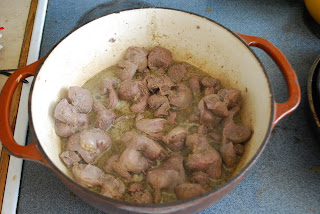
Meanwhile, peel and cube Sweet Potato, cut Onion into wedges and cut Celery at a bias.


Add half of vegetables to meat. Place in 300 degree oven for 3 hours or until tender, adding water occasionally if necessary.

At this point all of the sweet potatoes should have effectively broken down and, along with the now liquified fat and connective tissue from the gizzards, created a delicious gravy.

Add remaining vegetables and return to oven for 30 minutes or until sweet potatoes are fork tender. Serve on a platter and enjoy the deliciousness that ensues.
Due to the nature of organ meats, gizzards actually have a somewhat beefy taste (eg. minerally and mildly metallic) I won't pretend that this is a recipe that would fool anyone into thinking that they actually were eating beef pot roast but I do think that this is a splendid way to introduce "cheap cuts" of meat into your family's diet without having to convince anyone to eat it.

Its kind of like a birds set of teeth. I know, it looks nothing like that, but let me explain.
 |
| (photo credit) |
Now that you've had your biology lesson for the day I'll let you in on the question of the day "So what?". So what? I got 15lbs of turkey giblets for a rockin price thats so what!
First of all, I freakin love turkey. Secondly, growing up I have fond memories of going to the store and getting a package of fried chicken gizzards. I don't know if its because I live in a less ethnically diverse part of town now, or if that was some now antiquated hold over from the Wild West but they're tough to get right now. (Incidentally, here is a great lil recipe for Fried Gizzards in Buttermilk Brine to appease either your curiosity or in my case, nostalgia.)
 |
| (photo credit) |

Inexpensive, nutrient dense, delicous meats? Whats not to love? Well, since the gizzard is a muscular organ used to grind food it has a tendancy to be very tough, plus there is a significant amount of connective tissue. What do you do with tough meat full of connective tissue? Did anyone say potroast?!
Without further ado: Turkey Gizzard Pot Roast.
Ingredients:
2-3lbs Turkey Gizzards
2 tablespoons Coconut Oil
1 cup Poultry Stock
1 teaspoon Poultry Seasoning
1/4 teaspoon Salt
1lb Sweet Potatoes
1 large Onion
4 stalks of Celery
In a 4-6 quart cast iron dutch oven brown Gizzards in hot Coconut Oil. It is important that you use a cast iron dutch oven because the lid needs to be heavy enough to create a hot, stewing atmosphere inside of the pot without letting heat and moisture escape.
Combine the 1cup Poultry Stock (since we had some left in our bucket o' giblets I just used 1cup of blood) Poultry Seasoning and Salt. Pour over Gizzards and bring to boil.

Meanwhile, peel and cube Sweet Potato, cut Onion into wedges and cut Celery at a bias.


Add half of vegetables to meat. Place in 300 degree oven for 3 hours or until tender, adding water occasionally if necessary.

At this point all of the sweet potatoes should have effectively broken down and, along with the now liquified fat and connective tissue from the gizzards, created a delicious gravy.

Due to the nature of organ meats, gizzards actually have a somewhat beefy taste (eg. minerally and mildly metallic) I won't pretend that this is a recipe that would fool anyone into thinking that they actually were eating beef pot roast but I do think that this is a splendid way to introduce "cheap cuts" of meat into your family's diet without having to convince anyone to eat it.
Wednesday, October 26, 2011
Its Snowing Outside: Perfect Time to Work on the Garden
As I write this post I am looking out my window onto my backyard which is covered in 6inches of snow and I'm thinking "perfect time of year to work on the garden."

Don't get me wrong, I'm not going to go trudging through the snow to plant seeds or anything but late Autumn and early Winter are crucial times to work on your garden; although, its not what most people think.
The first lesson when it comes to gardening is that making an effective garden is a year-round activity, at least if you want it to be healthy and fruitful. Sadly the majority of hobbyist/backyard gardeners only think of their garden when they walk by the potted plants at Lowes in early Spring. But if you haven't done anything with your garden by then, its too late.
You may recall from some of my dumpstering exploits that I procured a reasonable amount of lumber by which I was able to make two nice new garden beds. Because last year I spent way more money buying dirt and manure trying to fill the bed than I could have ever imagined (let alone the fact that nothing makes you feel more like a fool than buying dirt) I vowed to utilize only free sources to fill these new beds.
An added benefit to using this approach instead of buying commercial top soils and fertilizer is that you can have a healthy organic garden which can produce as well, if not better. To achieve this free, organic, biodiverse soil for your garden bed you first have to understand few things. Well... really only one thing actually: decomposition.
For decomposition of organic materials (the crucial ingredient in any good soil) you need: life (worms, insects, bacteria etc.), water (to encourage the life and to expand the cellular structure of the organic material) and time (often much less than you'd think if you have enough of the other two).
Soil is simply a combination of minerals, decomposing organic matter, water and filler material. If you look at your average commercial bag of topsoil and you'll often see manure, humus, peat moss and vermiculite. Translation of all of those things? Rotting stuff and filler. Just because it is simple though does not mean that it isn't vital in fact Colorado State University is currently engaged in a global campaign to revitalize soil. Plus, as President Roosevelt once said during the Dust Bowl crisis in America, "A nation that destroys its soil, destroys itself."
When starting a new garden bed there are several schools of thought in regard to preparing the site, many people will recommend things like tilling, either by hand or with a powered tiller. This is a good idea, as it loosens the soil and introduces air into the soil (something that many people neglect to realize plants need too). However, I'm a bit of a pragmatist when it comes to work, in as far as I don't care to do more of it than necessary. That being said, I prefer the "lazy man's" approach to preparing the site: laying down cardboard.
Cardboard is easily sourced from.. just about everywhere, dumpsters, your own packaging refuse, or any grocery/department/liquor store will gladly give you more than you can take.
The cardboard that I laid down in our new beds serves a few important functions. First of all, it creates a barrier for preexisting weeds so that they do not spring up from below when it comes time to plant your edibles. While this dense cardboard barrier is enough to keep weeds from popping up it is also permeable, organic matter. Once it has had sufficient water and time to decompose it will provide additional nutrients to the soil as well as be soft enough for the roots of your jack-o-lantern pumpkins to reach down through.
However, the most important function which this wet layer of cardboard provides is an ideal habitat for worms. Worms are the hard workers that do the tilling and aeration for you, if you just give them the right environment, food and time to do the work. Not only is allowing worms to till your garden for you a less work intensive approach, but it is in fact more effective than hand tilling because it gives the added benefit of worm castings (aka. poo). I'm not enough of a scientist to know precisely how or why, but decomposed material which has been consumed, digested and expelled by worms has a significantly higher amount of certain important garden nutrients like phosphorus and nitrogen than if the organic material were left to decompose by itself.
This is part of the reason this snowy, cold, wet, time of year is ideal to do these kinds of garden preparations, because enough moisture (by means of snow), time (by means of passing through the non-growing season) and encouraged decomposition (thanks to expansion and contraction of water logged celluar structures) takes place that by the time next spring rolls around you'll have a lovely dark, rich, worm ridden soil to plant your delicious lovies in.
The next step, after laying down your cardboard is to lay alternating layers of "greens" and "browns". Greens are things like: grass clippings, kitchen scraps, rotten jack-o-lanterns etc. Browns are things like: dead leaves, corn husks and mulch.
This time of year is often a great time to layer your kitchen scrap sourced "green" heavy compost because it has already had several months of hot weather, insects (flies, pill-bugs etc.) and moisture to allow for the scraps to compost nicely. Its a perfect time of year to empty out your compost bin into your aspiring garden beds.
As for this time of year being a good time for "browns", I think you can look out at your leaf covered lawn and only guess. There are lots of good ways to get "browns" but frankly I can't think of a more universally beneficial strategy than to use the leaves from the trees around you, which so graciously have decided to fall down for easy pickings. You get to clean up your lawn, you get to add nutrients to your garden, you get to provide a insulation to the decomposing "greens" between each layer, and you don't contribute to our already over extended landfills. If you're nice I bet your neighbors will even let you have their leaves too!
Once you have laid alternating 2inch layers of "greens" and "browns" until your garden bed is full, the last step is: wait. Simply let the worms do their job underneath, the organic materials throughout decompose and the snow, rain, and sun encourage the whole process.
Thanks to a little proactive work in the late Autumn and early Winter you can enjoy soil that retains water, but allows it to drain and is full of rich organic nutrients but resists the growth of unwanted weeds by next Spring when you're ready to plant.


Don't get me wrong, I'm not going to go trudging through the snow to plant seeds or anything but late Autumn and early Winter are crucial times to work on your garden; although, its not what most people think.
The first lesson when it comes to gardening is that making an effective garden is a year-round activity, at least if you want it to be healthy and fruitful. Sadly the majority of hobbyist/backyard gardeners only think of their garden when they walk by the potted plants at Lowes in early Spring. But if you haven't done anything with your garden by then, its too late.
You may recall from some of my dumpstering exploits that I procured a reasonable amount of lumber by which I was able to make two nice new garden beds. Because last year I spent way more money buying dirt and manure trying to fill the bed than I could have ever imagined (let alone the fact that nothing makes you feel more like a fool than buying dirt) I vowed to utilize only free sources to fill these new beds.
An added benefit to using this approach instead of buying commercial top soils and fertilizer is that you can have a healthy organic garden which can produce as well, if not better. To achieve this free, organic, biodiverse soil for your garden bed you first have to understand few things. Well... really only one thing actually: decomposition.
For decomposition of organic materials (the crucial ingredient in any good soil) you need: life (worms, insects, bacteria etc.), water (to encourage the life and to expand the cellular structure of the organic material) and time (often much less than you'd think if you have enough of the other two).
Soil is simply a combination of minerals, decomposing organic matter, water and filler material. If you look at your average commercial bag of topsoil and you'll often see manure, humus, peat moss and vermiculite. Translation of all of those things? Rotting stuff and filler. Just because it is simple though does not mean that it isn't vital in fact Colorado State University is currently engaged in a global campaign to revitalize soil. Plus, as President Roosevelt once said during the Dust Bowl crisis in America, "A nation that destroys its soil, destroys itself."
When starting a new garden bed there are several schools of thought in regard to preparing the site, many people will recommend things like tilling, either by hand or with a powered tiller. This is a good idea, as it loosens the soil and introduces air into the soil (something that many people neglect to realize plants need too). However, I'm a bit of a pragmatist when it comes to work, in as far as I don't care to do more of it than necessary. That being said, I prefer the "lazy man's" approach to preparing the site: laying down cardboard.
 |
| Charlotte helping flatten out the cardboard scraps. |
 |
| (photo credit) |
 | |||
| Charlotte's jack-o-lantern "Nice Guy" (ps. thats not a real knife she has) |
This is part of the reason this snowy, cold, wet, time of year is ideal to do these kinds of garden preparations, because enough moisture (by means of snow), time (by means of passing through the non-growing season) and encouraged decomposition (thanks to expansion and contraction of water logged celluar structures) takes place that by the time next spring rolls around you'll have a lovely dark, rich, worm ridden soil to plant your delicious lovies in.
 |
| Enjoying the fruits of last year's soil preparations. |
This time of year is often a great time to layer your kitchen scrap sourced "green" heavy compost because it has already had several months of hot weather, insects (flies, pill-bugs etc.) and moisture to allow for the scraps to compost nicely. Its a perfect time of year to empty out your compost bin into your aspiring garden beds.
 |
| Raking in a year's worth of kitchen compost |
 |
| (photo credit) |
Thanks to a little proactive work in the late Autumn and early Winter you can enjoy soil that retains water, but allows it to drain and is full of rich organic nutrients but resists the growth of unwanted weeds by next Spring when you're ready to plant.
Wednesday, October 19, 2011
Pork and Pumpkins Are So Appetizing!
 |
| Pork and Pumpkin with Bacon and Red Wine sauce, sprinkled with Roasted Pepitas and Pecans! |
 |
| What do these things all have in common- other than being delicious that is? |
1 pie pumpkin
1-2 lb pork roast, fat trimmed, cut into 1 inch chunks
1 package nitrate/nitrite free bacon, cut into 1 inch pieces before frying
About 1 tablespoon ground cinnamon
About 1/2 tablespoon ground cumin
Salt and freshly ground black pepper to taste
1/2 cup red wine
2 tablespoons organic sucanat or other dry sugary thing like rapadura, etc.
Roasted Pumpkin seeds or Roasted Crispy Pecans
 |
| What? You don't keep a pumpkin peeler in your drawer? |
 |
| Save the seeds! But for more immediate use than usually suggested |
 Here's my pumpkin chunks on the roasting pan ready to go. I added about half a stick of butter, sliced up all over the place, and a few pieces of fat from the piece of ham I used- just for flavor. Lard would probably work well here, but I don't have any.
Step 3- Sprinkle salt, pepper, and cinnamon over the whole thing, then stick in an oven preheated to 415. Roast the whole thing until they are tender but NOT mushy. 20 minutes did it for me, but it will depend on the size of your thumb- ahem, I mean pumpkin chunks.

(Step 3 1/2- fry your bacon. Cut the bacon into 1/2 inch strips before frying- it'll go faster and be easier in the end. Don't let them get too crispy- then you can't put them on the toothpicks! You can do all this while you're chopping and roasting, so whenever you want to make your bacon is fine by me, as long as it's before....)
Step 4- Cut your pork roast up into similarly thumb-like portions. You could roast along with the pumpkin, but I was afraid that they would take different amounts of time, so I pan fried them in the bacon fat that was left over from cooking the bacon Which turned out beautifully. I added salt, pepper, cinnamon and cumin powder to the meat before sauteing. Then you're left with this-
 |
| Pan full of beautiful "Pan Scab" and some bacon pieces |
 |
| Just about ready- it's bubbling, but as long as you keep stirring, it won't burn |
 |
| YUMBO!! |
Then Sprinkle your roasted Pumpkin seeds over top, and maybe a few roasted Crispy Pecans, if you'd like. Pecans make everything better to me, so I did. It just gives you something to scrap the plate with when the meat's all gone.
Step 7- ENJOY!
 |
| A close up of the finished product- pumpkin, bacon, and pork- amazing! |
 | ||
| Surprise! My husband makes funny faces when things are delicious! |
 Linking up to GNOWFGLINS
 |
| Linking up to Real Food Wednesdays! |

Monday, October 17, 2011
Sustainable Patriotism
I recently heard a story on NPR regarding the first televised presidential address, despite economic woes and post-war needs for revitilization President Truman's address was about food, well... more about eating.
During his address he recommended (well...recommended like the guilt inducing recomendation of a stern grandmother) to the American people that they should adopt a few simple eating rules so that those in Europe (and America for that matter) would have enough to eat as nations rebuilt after the war.
The food rules he suggested were:
1- No meat on Tuesdays.
2. No poultry or eggs on Thursdays
3. Save a slice of bread every day.
4. Public eating places will serve bread and butter only on request.
I was intrigued by these rules as soon as I heard them. Partially because I already ascribe to a modified version of them (fasting on Fridays etc.) Also, having grown up in Colorado during a decade of drought I am familiar with a similar "by request" imposition at restaurants in an attempt to conserve water.
As a patriot (not a nationalist, mind you, a patriot) I am deeply interested in the notion of growing toward not self-sufficiency but community sufficiency. While doing some more research on President Truman's food rules I stumbled across an article which expanded on the fruits of reducing the national consumption of meat by means of reducing the household's consumption of meat.:
"If every family will reduce voluntarily its consumption of meat, whether it now has meat on the table three, four, five, or six days a week, the nation will achieve a maximum saving of meat and reduce the demand for grain to feed cattle and hogs. This will also produce a downward pressure on meat prices, and help curb living costs."
I know that the news is rife with the pros and cons of the dreaded "austerity measures" that certain countries (including our own) are seeking to adopt but frankly as the old cliche' goes "all politics is local". If every family utilized less resources and also shared the surplus resources with those in their community there would be ample food(/shelter/housing etc.) to go around, regardless of the unemployment rate, the threat of double dip recession or whatever politician jargon is currently a "threat to the nation's future."
That being said, we have come up with our own, amended and expanded, food rules list so that we can reduce our own consumption and allow for less fortunate members of our community to have enough when we have more than enough. I'm not a big bumper sticker slogan guy but "live simply so that others may simply live" is just too poetically true to be ignored.
Anyway here they are, the Catholic, Patriotic, Sustainable Family Food Rules:
1- No meat on Fridays.
2- No poultry or eggs on Wednesday.
3- Use "cheap cuts" of meat for at least 1 meat meal each week.
4- Monday is soup/stew day.
5- Make only enough food to feed the family at each meal.
6- Treats only on feast days or important family holidays.
The break down of our motivation for these food rules is relatively simple.
First of all, we already ascribe to a meatless fast on Fridays as our form of Friday penance. While our diocese does not require meatless fasting it is a nice way to nod to tradition as well as share in sacrifices of our brethren around the world who are obliged to the meatless fast.
Fasting on Wednesday is also something traditionally Catholic in honor of St. Joseph. Rather than extending an additional meatless day outright Britt and I have been discussing options for other small sacrifices we can make. This one may actually be more difficult than the meatless Fridays because a substantial amount of our protein comes from chicken, turkey and eggs. With that in mind though, it should make the fast more efficacious both spiritually and secularly.
Rule 3's adoption on the other hand was strongly influenced by my (albeit brief) research into the Truman food rules. From the article I mentioned earlier: "...suggested also that housewives buy the cheaper cuts and grades of meat, rather than choice steaks and chops, to bring down prices and reduce waste...75 per cent of the cheaper meats were not being used on the average American dinner table. If the housewife will make greater use of the cheaper cuts we will have about 25 per cent more use of the entire animal. This will help feed starving Europe and cut our meat bills at home. All that is needed is for the housewife to learn how to cook the cheaper cuts. They are fully as nutritious as the choice cuts if properly prepared. Unskillful cooking will, of course, produce unpalatable dishes. It is time the American housewife learned how to cook the cheaper cuts." Beyond the sustainability and economy of using the whole animal, our self-education regarding Whole Food diets has shown that some of the "less desirable" cuts of meats are in fact more nutrient dense than others. Boneless, skinless chicken breast for example is actually pretty weak when it comes to chicken options. My housewife has already begun some of this by making wonderful, nutrient dense bone broths from our "left over" bones. I'm sure she is also eager to investigate other ways to incorporate "mystery meats" into our regular diet.
Which brings us to soup/stew Mondays. Part of the reason is that if we are making these splendid broths from bones, fat, celery trimmings, carrot tops etc. we might as well take advantage of them and get a fully gamut of meals out of our food (stay tuned for a future post about how to make an entire week's worth of dinners from one roast chicken!). The other thing is that soups and stews are notorious ways to make a little bit of food go a long way. If you start with a nutrient dense bone broth, you needn't add any meat, or if so, very little and the rest (beans, carrots, potatoes etc) end up acting as texture and filler more than needed mineral and nutrient contributors.
Rule 5 has a loose association with the Truman food rules in that rather than "saving a piece of bread" each day, we only make enough food to feed us each day, thereby saving bread (or meat or veggies or whatever) because its not even set on the table. This has an added benefit of healthful portion control and digestive health. We should eat until we are no longer hungry, NOT until we are full.
The final rule is probably the most sensible, but strangely the most difficult. Americans love treats, snacks, novelty foods, easy foods, appetizers etc. But frankly a lesson I know from our Catholic fasting practices is that feast days are always more delicious and celebratory when they are special...go figure. The interesting thing is that our Faith is all about feasting, in fact a big feast is one thing we're all looking forward to for eternity. So this rule boils down to no special treats (beer, ice cream, cake, going out to eat etc.) unless it is Sunday, a feast day or a very important family holiday. By abstaining from those special treats day to day we allow them to remain special when the time for celebration comes.
Finally, beyond consuming no more than our share of resources, saving money, reducing the strain on our farm/graze lands, there is a wonderful side effect that our family is looking forward to: aid in planning. Britt mentioned that she is undertaking the Plan-It-Don't-Panic meal planned challenge. How much easier is it to know that Friday will be meatless, Wednesday won't use eggs or chicken and that we're having soup on Monday? It just becomes a game of fill in the blank after that.
 |
| Photo Credit |
During his address he recommended (well...recommended like the guilt inducing recomendation of a stern grandmother) to the American people that they should adopt a few simple eating rules so that those in Europe (and America for that matter) would have enough to eat as nations rebuilt after the war.
The food rules he suggested were:
1- No meat on Tuesdays.
2. No poultry or eggs on Thursdays
3. Save a slice of bread every day.
4. Public eating places will serve bread and butter only on request.
I was intrigued by these rules as soon as I heard them. Partially because I already ascribe to a modified version of them (fasting on Fridays etc.) Also, having grown up in Colorado during a decade of drought I am familiar with a similar "by request" imposition at restaurants in an attempt to conserve water.
As a patriot (not a nationalist, mind you, a patriot) I am deeply interested in the notion of growing toward not self-sufficiency but community sufficiency. While doing some more research on President Truman's food rules I stumbled across an article which expanded on the fruits of reducing the national consumption of meat by means of reducing the household's consumption of meat.:
"If every family will reduce voluntarily its consumption of meat, whether it now has meat on the table three, four, five, or six days a week, the nation will achieve a maximum saving of meat and reduce the demand for grain to feed cattle and hogs. This will also produce a downward pressure on meat prices, and help curb living costs."
I know that the news is rife with the pros and cons of the dreaded "austerity measures" that certain countries (including our own) are seeking to adopt but frankly as the old cliche' goes "all politics is local". If every family utilized less resources and also shared the surplus resources with those in their community there would be ample food(/shelter/housing etc.) to go around, regardless of the unemployment rate, the threat of double dip recession or whatever politician jargon is currently a "threat to the nation's future."
 |
| photo credit |
Anyway here they are, the Catholic, Patriotic, Sustainable Family Food Rules:
1- No meat on Fridays.
2- No poultry or eggs on Wednesday.
3- Use "cheap cuts" of meat for at least 1 meat meal each week.
4- Monday is soup/stew day.
5- Make only enough food to feed the family at each meal.
6- Treats only on feast days or important family holidays.
The break down of our motivation for these food rules is relatively simple.
First of all, we already ascribe to a meatless fast on Fridays as our form of Friday penance. While our diocese does not require meatless fasting it is a nice way to nod to tradition as well as share in sacrifices of our brethren around the world who are obliged to the meatless fast.
Fasting on Wednesday is also something traditionally Catholic in honor of St. Joseph. Rather than extending an additional meatless day outright Britt and I have been discussing options for other small sacrifices we can make. This one may actually be more difficult than the meatless Fridays because a substantial amount of our protein comes from chicken, turkey and eggs. With that in mind though, it should make the fast more efficacious both spiritually and secularly.
Rule 3's adoption on the other hand was strongly influenced by my (albeit brief) research into the Truman food rules. From the article I mentioned earlier: "...suggested also that housewives buy the cheaper cuts and grades of meat, rather than choice steaks and chops, to bring down prices and reduce waste...75 per cent of the cheaper meats were not being used on the average American dinner table. If the housewife will make greater use of the cheaper cuts we will have about 25 per cent more use of the entire animal. This will help feed starving Europe and cut our meat bills at home. All that is needed is for the housewife to learn how to cook the cheaper cuts. They are fully as nutritious as the choice cuts if properly prepared. Unskillful cooking will, of course, produce unpalatable dishes. It is time the American housewife learned how to cook the cheaper cuts." Beyond the sustainability and economy of using the whole animal, our self-education regarding Whole Food diets has shown that some of the "less desirable" cuts of meats are in fact more nutrient dense than others. Boneless, skinless chicken breast for example is actually pretty weak when it comes to chicken options. My housewife has already begun some of this by making wonderful, nutrient dense bone broths from our "left over" bones. I'm sure she is also eager to investigate other ways to incorporate "mystery meats" into our regular diet.
Which brings us to soup/stew Mondays. Part of the reason is that if we are making these splendid broths from bones, fat, celery trimmings, carrot tops etc. we might as well take advantage of them and get a fully gamut of meals out of our food (stay tuned for a future post about how to make an entire week's worth of dinners from one roast chicken!). The other thing is that soups and stews are notorious ways to make a little bit of food go a long way. If you start with a nutrient dense bone broth, you needn't add any meat, or if so, very little and the rest (beans, carrots, potatoes etc) end up acting as texture and filler more than needed mineral and nutrient contributors.
Rule 5 has a loose association with the Truman food rules in that rather than "saving a piece of bread" each day, we only make enough food to feed us each day, thereby saving bread (or meat or veggies or whatever) because its not even set on the table. This has an added benefit of healthful portion control and digestive health. We should eat until we are no longer hungry, NOT until we are full.
The final rule is probably the most sensible, but strangely the most difficult. Americans love treats, snacks, novelty foods, easy foods, appetizers etc. But frankly a lesson I know from our Catholic fasting practices is that feast days are always more delicious and celebratory when they are special...go figure. The interesting thing is that our Faith is all about feasting, in fact a big feast is one thing we're all looking forward to for eternity. So this rule boils down to no special treats (beer, ice cream, cake, going out to eat etc.) unless it is Sunday, a feast day or a very important family holiday. By abstaining from those special treats day to day we allow them to remain special when the time for celebration comes.
Finally, beyond consuming no more than our share of resources, saving money, reducing the strain on our farm/graze lands, there is a wonderful side effect that our family is looking forward to: aid in planning. Britt mentioned that she is undertaking the Plan-It-Don't-Panic meal planned challenge. How much easier is it to know that Friday will be meatless, Wednesday won't use eggs or chicken and that we're having soup on Monday? It just becomes a game of fill in the blank after that.
 Linking up with GNOWFGLINS
Tuesday, September 13, 2011
Guess what landed in our backyard: The Sequal
For all of you who were stumped by the images from our Guess what landed in our backyard post then brace yourselves for the answer:
*drumroll*
...I have no idea either.
What I do know is where it came from, which is certainly something and even more certainly less disconcerting. It was another dumpstering find, one that I wouldn't have taken home had Britt and I literally not just been talking about material to build an awning for our back porch that morning.
The object is... well, huge. I'm not particularly certain about its dimensions but spread out it nearly fills our backyard. That being said its likely somewhere around 1/4 acre. What is more shocking, and subsequently perplexing, about its size is that the piece we have is only about a quarter of the whole (I know because I saw the other 3 pieces laying near the dumpster as well.)
When I first picked it up I surmised it to be a billboard since many companies opt to use tarp style billboards instead of paying for the cost of painting and/or installation of more permenant billboard material. However, the dimensions on this thing are waaaaay too big to be a billboard. The "small" piece of it which we now poccess is probably a billboard size itself.
The other odd thing is that some of the text on it is only 2 or 3 inches tall, making it ineffective for billboard distances. What was this used for really? No idea, honestly. Based on the text and imagery it seems to have been some kind of advertisement for a phone company but this piece of material would have been seriously enormous.
Nevertheless, for our purposes its awsome. The material itself is some kind of rubberized plastic which makes it (as I'm sure was its intent) weatherproof. It also is actually a small mesh, which will allow for both (some) light as well as air to pass through the (for lack of a better word) fabric.
This is wonderful news for two reasons: First of all, this material will be essentially ideal for the awning which we are looking to make for our back porch. Allowing some light, but providing shade, and also able to stand up to sun and other harsh elements.
The other benefit of the material, since we have more than enough to spare, is that it should also function as a pretty useful cold frame for our garden bed. We have a funny growing season here, we have enough sun for many months, but frosts come in pretty early sometimes. Hopefully this material will be both insulative and permeable enough to give us another month or two of growing for our new crops of spinach, swiss chard, beets, kale and winter squash. Maybe pumpkins too, providing our dachshund doesn't eat any more of them.
*drumroll*
...I have no idea either.
What I do know is where it came from, which is certainly something and even more certainly less disconcerting. It was another dumpstering find, one that I wouldn't have taken home had Britt and I literally not just been talking about material to build an awning for our back porch that morning.
The object is... well, huge. I'm not particularly certain about its dimensions but spread out it nearly fills our backyard. That being said its likely somewhere around 1/4 acre. What is more shocking, and subsequently perplexing, about its size is that the piece we have is only about a quarter of the whole (I know because I saw the other 3 pieces laying near the dumpster as well.)
When I first picked it up I surmised it to be a billboard since many companies opt to use tarp style billboards instead of paying for the cost of painting and/or installation of more permenant billboard material. However, the dimensions on this thing are waaaaay too big to be a billboard. The "small" piece of it which we now poccess is probably a billboard size itself.
The other odd thing is that some of the text on it is only 2 or 3 inches tall, making it ineffective for billboard distances. What was this used for really? No idea, honestly. Based on the text and imagery it seems to have been some kind of advertisement for a phone company but this piece of material would have been seriously enormous.
Nevertheless, for our purposes its awsome. The material itself is some kind of rubberized plastic which makes it (as I'm sure was its intent) weatherproof. It also is actually a small mesh, which will allow for both (some) light as well as air to pass through the (for lack of a better word) fabric.
This is wonderful news for two reasons: First of all, this material will be essentially ideal for the awning which we are looking to make for our back porch. Allowing some light, but providing shade, and also able to stand up to sun and other harsh elements.
The other benefit of the material, since we have more than enough to spare, is that it should also function as a pretty useful cold frame for our garden bed. We have a funny growing season here, we have enough sun for many months, but frosts come in pretty early sometimes. Hopefully this material will be both insulative and permeable enough to give us another month or two of growing for our new crops of spinach, swiss chard, beets, kale and winter squash. Maybe pumpkins too, providing our dachshund doesn't eat any more of them.
Subscribe to:
Posts (Atom)